Image generation
hal0 exposes OpenAI-compatible image generation at
POST /v1/images/generations, served by a
ComfyUI provider running
inside the img slot. hal0 owns the OpenAI ↔ ComfyUI translation;
the upstream is treated as a black box that speaks POST /prompt,
GET /history/<id>, and GET /view.
The route is implemented in src/hal0/api/routes/v1.py and the
provider in src/hal0/providers/comfyui.py. Workflow templates live
under src/hal0/providers/workflows/.
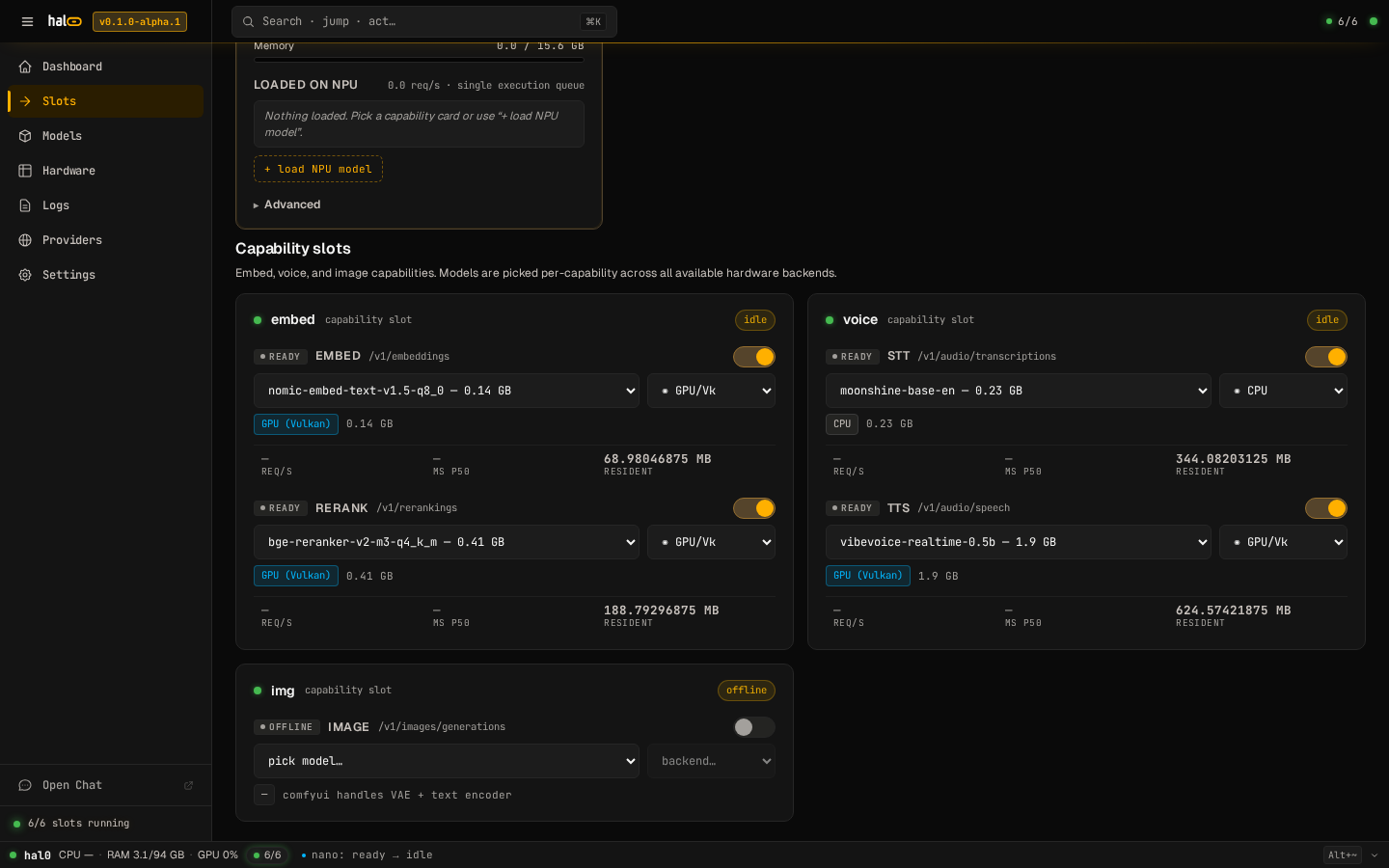
The img slot sits on the same lifecycle as the chat and embed
slots, so it shows up in the dashboard’s slot grid with the same
states, controls, and metrics.
Overview
Section titled “Overview”- Endpoint:
POST /v1/images/generations. - Slot:
img. Part ofBUILTIN_SLOTSinsrc/hal0/slots/manager.py, same lifecycle asprimary,embed,stt,tts. - Backend: ComfyUI inside the
ghcr.io/hal0ai/hal0-toolbox-comfyui:v1toolbox image (pinned by sha256 inhal0/manifest.json). - Hardware: ROCm-capable AMD GPU. Strix Halo’s iGPU is the reference target. The 128 GB unified pool keeps an SDXL Turbo checkpoint and a primary chat model warm at the same time.
Curated models
Section titled “Curated models”The picker UI surfaces three curated entries spanning the licensing
spectrum (see src/hal0/registry/curated.py):
| Id | Family | On-disk | Min VRAM | License |
|---|---|---|---|---|
sdxl-turbo | SDXL distilled | ~6.5 GB | 8 GB | SAI Non-Commercial Research Community |
sd-1.5-pruned-emaonly | SD 1.5 | ~4.3 GB | 4 GB | CreativeML Open RAIL-M |
flux-schnell | FLUX.1 [schnell] | ~23.8 GB | 24 GB | Apache-2.0 |
curl: image generation
Section titled “curl: image generation”curl http://localhost:8080/v1/images/generations \ -H "Content-Type: application/json" \ -d '{ "model": "sdxl-turbo", "prompt": "a cat in a hat, studio lighting", "size": "1024x1024", "response_format": "url" }'Honoured body fields (subset of OpenAI):
model(required). Curated id, e.g.sdxl-turbo.prompt(required).n. Batch size; default 1.size.WxHstring, e.g.1024x1024.response_format."url"(default) or"b64_json".
hal0 extensions via extra_body: seed, steps, cfg,
negative_prompt.
Response shape
Section titled “Response shape”{ "created": 1716000000, "data": [ { "url": "/api/images/cache/<uuid>.png" } ], "_hal0": { "workflow": "sdxl_turbo_simple", "checkpoint": "sd_xl_turbo_1.0_fp16.safetensors" }}When response_format is b64_json, each data[] entry carries
b64_json (base64-encoded PNG) instead of url. The _hal0 debug
field carries the workflow translator’s metadata so a misrouted prompt
is easy to diagnose.
Hardware requirements
Section titled “Hardware requirements”The v1 first-class target is a ROCm-capable AMD GPU, specifically the Strix Halo Ryzen AI Max+ 395 iGPU. SDXL Turbo runs comfortably alongside a small or mid chat model on a 128 GB unified pool; on a discrete AMD GPU you’ll want at least 8 GB of dedicated VRAM for SDXL Turbo, 4 GB for SD 1.5.
NVIDIA discrete GPUs are not yet wired. The ComfyUI provider defaults
to the rocm backend. See
the hardware overview for the full matrix
and follow the upstream roadmap for CUDA support.
Slot configuration
Section titled “Slot configuration”A minimal slots/img.toml is shaped like every other slot. The
default backend is rocm:
enabled = truebackend = "rocm"
[model]default = "sdxl-turbo"
After a model lands in the curated catalogue’s per-id directory under
/var/lib/hal0/comfyui/models/checkpoints/, start the slot:
hal0 slot load img --model sdxl-turboThe OpenAI-shaped /v1/images/generations request will route there
automatically; the dispatcher’s heuristics already pin /v1/images/*
to the img slot.
Limitations
Section titled “Limitations”- First-pull is heavy. The ComfyUI toolbox image is the largest
one hal0 ships. The CI build takes ~19 minutes and the layer set
is sizeable. Expect a long first
docker pullon a fresh box; subsequent restarts hit the local layer cache. - No perf claims yet. No verified seconds-per-image numbers are in the repo for ComfyUI on Strix Halo iGPU. Treat the curated models’ VRAM hints as the only published sizing data until a real measurement lands.
- Flux workflow. As above:
flux-schnellis catalogued but the default workflow can’t drive it. A Flux workflow is the gating item before Flux is fully picker-grade. - License spread. The three curated entries each have a
different license. The picker UI surfaces the badge so you pick
consciously; check the bundled
license_urlfield before shipping output anywhere production-facing.
See also
Section titled “See also”- What is a slot?. The
imgslot uses the same lifecycle asprimary,embed,stt,tts. - Provider matrix. Every backend hal0 ships, ComfyUI included.
- OpenAI-compatible API. The full
/v1/*surface, with curl examples for every endpoint.